

What Are Peptides Used For in Research? Key Applications Explained
- kwbarnes21
- Apr 5
- 2 min read
Introduction
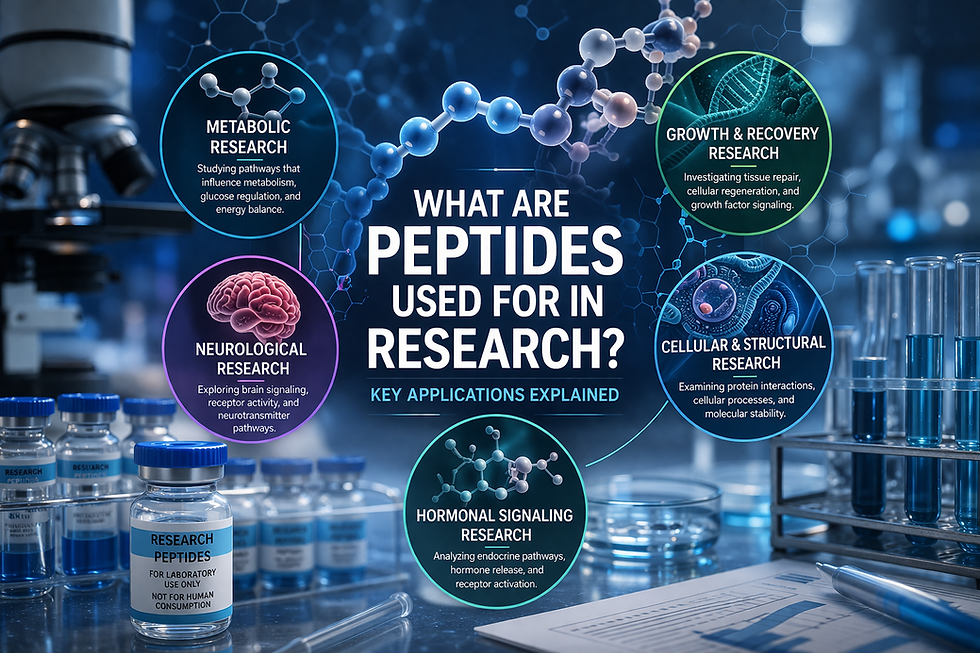
Peptides play a critical role in modern scientific research, with applications spanning multiple areas of study.
From metabolic signaling to cellular communication, peptides are used to explore complex biological processes in controlled laboratory environments.
Understanding how peptides are used in research helps provide context for their importance, functionality, and growing role in scientific advancement.
Peptides in Metabolic Research
One of the most widely studied areas involves peptides that influence metabolic pathways.
These compounds are used in research focused on:
glucose regulation
energy balance
signaling pathways
Examples include:
Peptides in Growth and Recovery Research
Certain peptides are studied for their role in growth signaling and cellular repair processes.
These research applications focus on:
tissue response models
cellular regeneration
signaling pathways
Examples include
BPC-157 Research Guide: Uses, Research Overview, and Peptide Basics➝ TB-500 Research Guide: Peptide Overview and Laboratory Interest
Peptides in Hormonal Signaling Research
Some peptides interact with hormonal pathways, making them useful for studying:
endocrine system responses
growth hormone signaling
receptor activation
Examples include:
Peptides in Cognitive and Neurological Research
Peptides are also explored in research related to neurological pathways and receptor activity.
These studies may involve:
central nervous system signaling
receptor binding behavior
neurological response patterns
Examples include:
Peptides in Structural and Cellular Research
Some peptides are used to study:
cellular structure
protein interaction
molecular stability
For example:
Scientific Perspective on Peptide Applications
Scientific literature highlights the expanding role of peptides across multiple research domains.
Why Peptide Applications Matter
Understanding how peptides are used helps researchers:
choose appropriate compounds
design better experiments
interpret results more accurately
It also reinforces the importance of:
quality
consistency
proper handling
For more on quality
The Expanding Role of Peptides in Research
As scientific tools and methodologies improve, peptide research continues to expand into new areas.
This includes:
more targeted molecular studies
improved analytical techniques
broader experimental applications
Final Thoughts
Peptides are used across a wide range of research applications, from metabolic studies to cellular signaling.
Understanding these use cases provides a clearer picture of their importance in modern scientific research and their role in advancing knowledge across multiple disciplines.


Comments